Learn More Contact Now Learn more about GeniusDV Video Training Classes - call toll-free: 866-566-1881

Avid Xpress Creating a Moving Film Strip

|

Here is an excellent tutorial that will teach you many of the basic compositing techniques available in Avid Xpress or Media Composer. Once you've mastered this technique, you can use the same skills to build moving walls, spinning 3D worlds, story-books, and a variety of other effects.

*Don't Worry if your a Final Cut Pro user, you can find the same steps for building a moving filmstrip with Final Cut Pro.

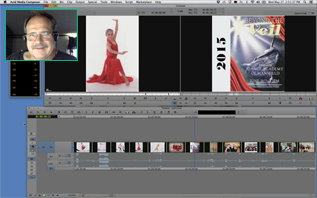
Here is what the finished sequence should look like when you are finished with this tutorial.

avid_composer_window.gif

The first step to creating a moving filmstrip with Avid Xpress is to find at least 6 clips and set a duration of 3 seconds for each of them.

To do this, double click on each clip within the Avid Xpress bin window and mark IN and OUT points for each clip so the duration of each clip is exactly 3 seconds.

avid_bin_window.gif

You may want to use the hidden source pull down menu and set the timecode display to I/O. This will help you when marking IN and OUT points for the clip so you have a visual reference.

It is very important that each clip is exactly 3 seconds long.

source_window

Within the Avid Xpress bin window, verify that all of your clips are exactly three seconds long. You can verify this by pulling down the fast menu in the lower left corner of the bin window and selecting headings.

Make sure you have the text tab selected at the top of the Avid Xpress bin window. Otherwise, you will not be able to access the headings selection within the fast menu.

avid_bin_headings

Next, select the IN-OUT heading within the Avid bin column section box.

You may want to click on the All / None button to deselect all the other unnecessary headings.

Verify that all of your clips have an IN-OUT value of exactly 3 seconds each.

in-out_column_heading

The next step is to edit each of your clips to the timeline window. You can save some steps by selecting all of the clips by using (control + A) on a PC or (command + A) on a MAC.

select_source_clips

After all of the clips are selected, you can drag all of them together directly to the Avid Xpress timeline window.

drag_to_timeline.gif

You may want to pull down the timeline (fast menu) and select (clip-durations) to verify that all of your clip segments are exactly three seconds in duration.

clip_durations_menu.gif

Next, you will want to delete all the audio tracks. This is because they will get in the way when building your final composite. To do this, deselect the video track, and highlight all of the audio tracks.

select_audio_tracks.gif

Then press the delete key on your keyboard. Click on the OK button to delete all of the Avid Xpress audio tracks within the timeline window.

delete_audio_tracks.gif

The next step is to add two additional video tracks. To do this, navigate to the clip menu, and select New Video Track. Repeat this process until you have a total of 3 video tracks.

new_video_track.gif

Within the Avid Xpress project window, select the effects tab. Within the effects tab, find the PIP effect. Drag the PIP effect to the first segment within the timeline as shown below.

apply_pip_effect.gif

After you drop the PIP effect onto the first segment, you need to enter into effects mode. Park the blue timeline position indicator over your first segment and push the segment mode button. The segment mode button looks like a pair of (seatbelts) and it is located in the upper left corner of the timeline window. After you click on the effects editor button, the Avid Xpress effects editor window will appear.

avid_effects_mode.gif

The Avid Xpress editor window is where you can adjust the parameters for any particular effect.

For now, leave all of the adjustments at their default positions.

avid_effects_editor.gif

While the effects editor is open, the composer window will change to 'Effects Mode' You should see a wireframe edge around your picture-in-picture effect.

composer_window_effects_mode.gif

While in 'Effects Mode' click on the reduce image icon. It is a magnifying glass with a minus sign. Click on this icon twice.

You will now be able to see the edge of the screen.

zoom_out_composer_window.gif

Click on the first keyframe within the Avid Xpress composer window. The keyframe will turn pink.

Then, drag the wireframe image to the right of the visible screen area.

set_first_keyframe.gif

Next, click on the last keyframe within the Avid Xpress composer window.

Then drag the wireframe image to the left of visible picture area.

*When dragging your wireframe image, DO NOT grab the image from the white dot in the middle. This white dot in the middle of the wireframe image represents the starting keyframe. You animation will then move backwards if you grab the image from the middle dot.

If you press the play button while in 'effects mode' you wireframe image should move from the right side of the screen to the left side of the screen.

set_second_keyframe.gif

Once you have built the first picture-in-picture effect, you need to copy the same effect to all the other segements.

You do this by draggin the effect from the Avid Xpress effects editor window, and copying it to all the other segments.

If you have six segments, you will have to repeat this process 5 times until each of your segments has the same picture-in-picture effect applied to it.

After you are done, close the effects editor window.

clip_pip.gif

Now, you need to move the blue position indicator forward exactly one second from the start of the sequence. Turn on the red segment arrow drag the next segment up onto V2 and snap it to the blue position indicator. *if you are using Avid Xpress Pro, hold down the control key to snap the segment to the head of the blue position indicator.

After you are done, move the position indicator forward 1 more second, and drag the third segment up onto V3 and snap to the position indicator.

stack_segments.gif

When you are finished, your sequence should look like the example shown below. Make sure you move the (monitor) icon to the top most track so you can see all of the layers below it.

monitor_track.gif

That's it! Now back up and play the sequence. You should have a moving filmstrip that moves across the screen.

Depending on how fast your machine is, you may need to render your sequence to play the sequence.

finished_filmstrip.gif

Receive FREE Tutorials by email:

Find on-site Genius training in:
Online and On-Site Training available on demand.
Orlando Classroom Schedule
December 2009
S M T W T F S
29 30 1 2 3 4 5
6 7 8 9 10 11 12
13 14 15 16 17 18 19
20 21 22 23 24 25 26
27 28 29 30 31 1 2
3 4 5 6 7 8 9
  Dec 7th -- Dec 11th  
  Final Cut Studio Training
 
  Dec 10th -- Dec 11th  
  Google Sketchup Training
 
  Jan 4th -- Jan 8th  
  Media Composer Training
 
  Jan 11th -- Jan 15th  
  Final Cut Studio Training
 
  Jan 18th -- Jan 20th  
  After Effects Training
 
  Feb 8th -- Feb 12th  
  Final Cut Studio Training
 
  Feb 15th -- Feb 17th  
  After Effects Training
 
  Mar 1st -- Mar 5th  
  Media Composer Training
 
  Mar 8th -- Mar 12th  
  Final Cut Studio Training
 
  Mar 15th -- Mar 17th  
  After Effects Training
 
 
Search Our Tutorials:
about.this

The DV Show Podcast goes Skypecast! was the previous entry in this blog.

Final Cut Pro filmstrip effect is the next entry in this blog.

Find recent content on the main index or look in the archives to find all content.