Recently in Video Production and Hardware Category
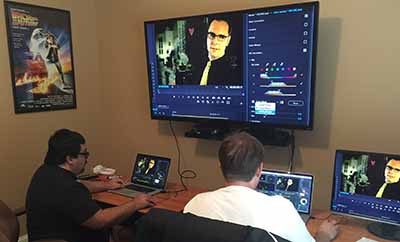
DaVinci Resolve 9 Training
Day 1: Basics
- Setup and Interface—Designing a color grading environment; configuring your system; managing DaVinci users, projects, storage volumes, and media pools; getting around the new DaVinci interface; software-only operation vs control surfaces.
- Using Scopes—DaVinci's high-performance instruments provide detailed feedback for color-critical decisionmaking. Learn to get the most out of your color suite's waveform monitors, vectorscope, and histograms, using them for both technical and artistic guidance.
- Primary Corrections—Use the color wheels, mixers, Camera Raw panel, and Primary controls to adjust each shot's overall exposure and color balance
- Qualifiers—Selectively adjust specific parts of a video image on the basis of hue, saturation, or luma constraints
- Power Windows and Tracking—Create vignettes, relight scenes, and isolate specific surfaces in your shot for adjustment
Day 2: Workflows and Advanced Techniques
- Managing Nodes—Configure node trees to avoid redundant isolation work and create nuanced looks
- Balance and Consistency—Color-theoretical strategies to create balance and structure in individual shots and harmonize successive shots in an edit
- To and From the NLE—Send projects to and from Final Cut, Avid, and Premiere; online and offline workflows; conform to changes in your edit
- ColorTrace, Scene Detection
- Managing Grades—Recycle grades between shots and projects, maintain a library of looks, manage and apply LUTs
- Workshop: Creating moods—Working with their own clips or clips from our extensive library, the class will use all of DaVinci's tools to develop complete moods for short edits. We'll then workshop each student's color grade, with the instructor providing expert feedback and fellow students providing reactions as well as examples of their own personal approaches.
Whether you are a Final Cut Pro user, Avid Media Composer user, or Premiere user, we'd like to introduce you to Adobe On Location. In our opinion, this is an incredible application that is sometimes overlooked in the professional video industry.
It ships with the Adobe Creative Suite Production Premium. Trust us on this one, this software is really a nice addition to any video production professional.
Do you own a HDV camera which records to MiniDV cassette tapes,
and have wondered what to do about it? I have given my Canon XHA1S the evil eye
for some time now, but have not decided to upgrade to another model. The
technological advances come so fast that it is difficult to make a reasonable
choice, and waiting a few months may be priceless. ![]()
Adobe On Location may be the tool that helps you improve your footage until you are certain of what to do after HDV.
You've asked for it, now it's here. GeniusDV is currently developing weekend training classes at our brand new facility! Our first Weekend Video Production training class is now scheduled for September 17 & 18. If you're looking to get into Video Production, this is the place to start. The training covers everything from camera settings to lighting to audio techniques to setting up a shoot. Get to know your own camera, or you can explore with one of ours. Most of our students who've already been shooting with their own camera, will come out of this class saying, "I didn't even know my camera could do that!" Learn in-camera editing, so your footage is ready to go straight to the web. Let's face it, anybody can point & shoot, but it takes knowledge, information, and education to become a great storyteller. So why not get started today...contact us at 866-566-1881 and get your Video Production training class scheduled. Class size is kept small and fills up quickly, so reserve your seat now.
Summer Session- Hands-on. Our classrooms are fully equipped-you'll work hands-on at your own workstation during lab and lecture. Our world-class instructors teach every course based on true-to-life exercises, not just talking.
- Fast-paced. All summer courses are in a 9-5 format, so you'll be immersed in video all day. View Summer Term schedule
- Career-oriented. During the Summer Session, you'll producing samples of your work in lab and through your assignments in the field. By the end of the term, you'll add this work to your demo reel. With a state-licensed Diploma on your résumé and a rich demo reel in your portfolio, you'll impress potential employers and potential clients.

If you want your lighting to look more professional, you'll want to give special consideration to "color temperature" especially when you're mixing light sources. A great way to change the color of your lighting is by using color correcting gels. Gels are small plastic transparent sheets that can be mounted onto your lights. Outdoor lighting with a higher light temperature appears to have a blue hue or a "cooler" feel to them, whereas Indoor lighting with a lower light temperature appears to have a more yellow or "warmer" hue. By using color correcting gels, you can match different light temperatures. 2 of the most common gels used are Color Temperature Orange, and Color Temperature Blue, often referred to as CTO and CTB respectively. Color Temperature Orange gels allow you to turn the higher temperature or "cooler" light sources into warmer ones and Color Temperature Blue gels allow you to make lower temperature or "warm" light appear cool. Gels are also available in different intensities from dark to pale, so you may have to experiment to achieve the look you want. Some other types of gels that can be used include Plus and Minus Green gels, Neutral Density gels, Diffusion gels, and Color or Theatrical gels. Plus and Minus Green gels can be used when mixing fluorescent lights with daylight or incandescent lights since fluorescent lights give off a greenish hue. Neutral Density gels are gray and rather than changing the color temperature, they merely cut down the lighting, making it softer and less intense. Diffusion gels work pretty much in the same way, as they are frosty or milky white, and do not change the color temperature, rather just soften the light. Color or Theatrical gels are used to accent or create dramatic unnatural effects or actually to add a specific color to your "stage".
Remember to replace your gels over time since they can become brittle or fade from the heat of your lamps, thus changing the degree of your color correction.

To learn more about successful lighting techniques, why not try out one of our Video Production training classes; Call today!