Learn More Contact Now

Recently in Adobe Production Suite Category

Whether you cut on FCP, Avid, or Premiere, chances are you're doing some color correction work from time to time.  And with the new release of DaVinci Resolve, chances are you could be doing that color correction work faster and better at next to no cost at all.  We used to think of DaVinci as expensive, complicated, and tricky to integrate with mainstream workflows.  That's not true any longer.

If you're working at HD resolutions, a fully functional commercial license for DaVinci Resolve's Lite edition is free.  $0.  And Version 9 boasts a slick new interface that's been completely overhauled for speed and ease of use.  So no matter how big or small your firm is, you too can be a DaVinci guy or girl.

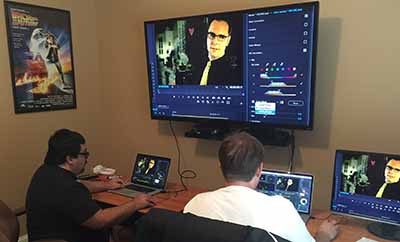
We're excited.  So excited that we and our crack team of colorists have developed a spiffy two-day course around the new DaVinci Resolve.  Come to Orlando and learn DaVinci with us—details are below.  For that matter, we'd love to come on-site with you and get you cooking with the new Resolve!


DaVinci Resolve 9 Training

Have you been thinking about bringing high-end color grading into your edit suite?  The time to learn DaVinci has never been better.  Blackmagic has priced its full commercial license of DaVinci Resolve Lite at the irresistible price of free, they've fully revamped Resolve's user interface, and now you can get up to speed in a matter of days not weeks with GeniusDV's intensive personalized training!
blackmagic-davinci.png
The DaVinci is the same top-of-the-line coloring suite that the finest coloring houses use to grade major films and Super-Bowl-class commercial spots.  Now that elite toolset makes sense for even the most cost-conscious post production house.  With your GeniusDV training, you'll be all ready to fix problematic shots, guarantee consistency across the shots in each edit, relight scenes, amplify your pieces' moods, and apply the visual polish to help your video stand out.  And you'll be amazed at how fast the DaVinci workflow has become.

Are you an Adobe Creative Suite user?  We're currently developing Adobe SpeedGrade training.  Please contact us at (866)566-1881 for details and a discounted rate on our SpeedGrade courses while they're in development.

Day 1: Basics

  • Setup and Interface—Designing a color grading environment; configuring your system; managing DaVinci users, projects, storage volumes, and media pools; getting around the new DaVinci interface; software-only operation vs control surfaces.
  • Using Scopes—DaVinci's high-performance instruments provide detailed feedback for color-critical decisionmaking.  Learn to get the most out of your color suite's waveform monitors, vectorscope, and histograms, using them for both technical and artistic guidance.
  • Primary Corrections—Use the color wheels, mixers, Camera Raw panel, and Primary controls to adjust each shot's overall exposure and color balance
  • Qualifiers—Selectively adjust specific parts of a video image on the basis of hue, saturation, or luma constraints
  • Power Windows and Tracking—Create vignettes, relight scenes, and isolate specific surfaces in your shot for adjustment

Day 2: Workflows and Advanced Techniques

  • Managing Nodes—Configure node trees to avoid redundant isolation work and create nuanced looks
  • Balance and Consistency—Color-theoretical strategies to create balance and structure in individual shots and harmonize successive shots in an edit
  • To and From the NLE—Send projects to and from Final Cut, Avid, and Premiere; online and offline workflows; conform to changes in your edit
  • ColorTrace, Scene Detection
  • Managing Grades—Recycle grades between shots and projects, maintain a library of looks, manage and apply LUTs
  • Workshop: Creating moods—Working with their own clips or clips from our extensive library, the class will use all of DaVinci's tools to develop complete moods for short edits.  We'll then workshop each student's color grade, with the instructor providing expert feedback and fellow students providing reactions as well as examples of their own personal approaches.
The latest version of Photoshop adds a variety of new 3D features that make the software a valuable tool for all video editors.

A cool feature in Photoshop CS 6 is the ability to break a text object into individual glpyhs that can be altered and animated individually.

To keep this tutorial simple, it focuses on animating 3D characters within Photoshop CS 6.

Click on the title of this blog to read the full tutorial.

Adobe On Location

| | TrackBacks (0)

Whether you are a Final Cut Pro user, Avid Media Composer user, or Premiere user, we'd like to introduce you to Adobe On Location.  In our opinion, this is an incredible application that is sometimes overlooked in the professional video industry.

It ships with the Adobe Creative Suite Production Premium. Trust us on this one, this software is really a nice addition to any video production professional.

Do you own a HDV camera which records to MiniDV cassette tapes, and have wondered what to do about it? I have given my Canon XHA1S the evil eye for some time now, but have not decided to upgrade to another model. The technological advances come so fast that it is difficult to make a reasonable choice, and waiting a few months may be priceless.

Camera rig.jpg

Adobe On Location may be the tool that helps you improve your footage until you are certain of what to do after HDV.

Learn how to use the Photoshop vanishing function to map objects onto services to match the true perspective.

Continue reading for a full text transcript of this Photoshop CS5 tutorial.
Adobe Premiere Pro Icon

Image via Wikipedia

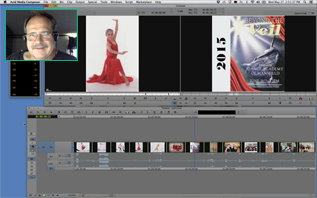
More and more of our students are exploring a move from Final Cut Studio to Adobe's Production Premium bundle of Creative Suite software–especially with Adobe's 50% discount for pros who switch.  If you're an FCP 7 editor, you'll feel right at home in Adobe Premiere, and you can be confident that the features you love most from Final Cut Pro are available, although they're probably hiding somewhere new.

For example, Final Cut Pro 7 places basic clip attributes in the Motion tab of the Viewer.  When you rotate, resize, crop or position a clip in the Canvas, you're really just taking a shortcut to set the clip's attributes that appear in the Viewer's Motion tab.  In Premiere, it's harder to manipulate clips' geometry directly in the "Canvas."
viewercontrols.png
Changing your clip's Wireframe in the Canvas actually changes attributes in the Viewer's Motion Tab

Continued after the jump...
Receive FREE Tutorials by email:

Find on-site Genius training in:
about.this

This page is a archive of recent entries in the Adobe Production Suite category.

Avid is the next category.

Find recent content on the main index or look in the archives to find all content.