Working with Portrait Stills in a Final Cut Pro Sequence
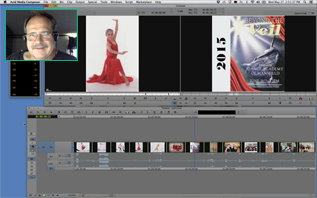
Do you ever have trouble tweaking your still images in Final Cut Pro, or worse yet, not tweak them at all? Last night I viewed a slide show for a friend (who is an amateur) that had several of these vertical images with the white showing on either side. At the very least, if he did nothing else to improve his slideshow, he could figure out a way to utilize that space on either side of his vertical images. I'm going to show you what I mean. Here is an example of just one way to work with this image.


What I've done here is bring in the image a little closer on each side
to blend it in with the original image. Do you see the difference
between the amateur image and my image? It's just so much more
pleasing to the eye. Ok, so how did I do it? First of all I brought
the image into my Timeline, and duplicated it by using the shortcut Opt+Shift and drag straight up to copy your image into the track above.

Next, I make sure my Image+Wireframe option is activated in the Canvas. Now I drag the bottom two images that are in my Timeline, out to either side of the main image using the center of the Wireframe. You may have to reduce your Canvas window size to see your Wireframe better. Remember to keep your main image on top.

Next move around your Wireframe to tweak both sides of your main image or pull out the Wireframe handles to make your side images larger or more close-up.

Once you get your side images to where you want them, there's only one last step, and that's to blend it all together. I did this by double-clicking on my main image to load it into the Viewer, click on the Motion Tab, and twirl down the disclosure triangle next to Crop. Move the Edge Feather slider all the way over to 100%, and notice how those sharp edges disappear.

It might sound like alot of tweaking, but once you get used to doing the steps a couple of times, it really doesn't take that much extra time, and it's well worth improving the image rather than seeing that blank space time after time. Here is another example of something creative we can do with those blank spaces.

In this example, all I've done is drop down the Opacity of each of the side images, and blended them together with an Edge Feather. You can change the Opacity again in the Motion Tab in the Viewer window.

Here is another example with the picture on the bottom zoomed in.
And another with just a simple color matte underneath the main image and the Edge Feather.

Another creative thing to do with this particular image is to give the main image or the top image some motion by using the Ken Burns Effect.
So I hope this gives you some examples of how to be creative when dealing with those darn vertical/portrait pictures. Whatever you do, don't leave those blank white spaces on the sides of your image. Get your creative juices flowing and try out some of these tricks today!

Next, I make sure my Image+Wireframe option is activated in the Canvas. Now I drag the bottom two images that are in my Timeline, out to either side of the main image using the center of the Wireframe. You may have to reduce your Canvas window size to see your Wireframe better. Remember to keep your main image on top.

Next move around your Wireframe to tweak both sides of your main image or pull out the Wireframe handles to make your side images larger or more close-up.

Once you get your side images to where you want them, there's only one last step, and that's to blend it all together. I did this by double-clicking on my main image to load it into the Viewer, click on the Motion Tab, and twirl down the disclosure triangle next to Crop. Move the Edge Feather slider all the way over to 100%, and notice how those sharp edges disappear.

It might sound like alot of tweaking, but once you get used to doing the steps a couple of times, it really doesn't take that much extra time, and it's well worth improving the image rather than seeing that blank space time after time. Here is another example of something creative we can do with those blank spaces.

In this example, all I've done is drop down the Opacity of each of the side images, and blended them together with an Edge Feather. You can change the Opacity again in the Motion Tab in the Viewer window.

Here is another example with the picture on the bottom zoomed in.
And another with just a simple color matte underneath the main image and the Edge Feather.

Another creative thing to do with this particular image is to give the main image or the top image some motion by using the Ken Burns Effect.
So I hope this gives you some examples of how to be creative when dealing with those darn vertical/portrait pictures. Whatever you do, don't leave those blank white spaces on the sides of your image. Get your creative juices flowing and try out some of these tricks today!
Listed below are 0 links to blogs that reference this entry: Working with Portrait Stills in a Final Cut Pro Sequence.
TrackBack URL for this entry: http://www.geniusdv.com/weblog/mt-tb.cgi/1365